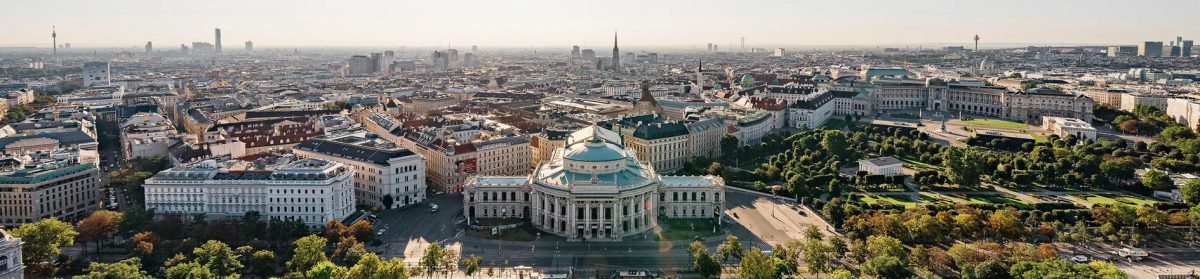

Tomorrow, Saturday, September 19, radio klassik Stephansdom offers Richard Wagner’s 1842 Rienzi on its Opernabend program at 2:00 pm Philadelphia time and 8:00 pm Vienna time. A brief synopsis from Wikipedia:
The opera is set in Rome and is based on the life of Cola di Rienzo (1313–1354), a late medieval Italian populist figure who succeeds in outwitting and defeating the nobles and their followers and in raising the power of the people. Magnanimous at first, he is forced by events to crush the nobles’ rebellion against the people’s power, but popular opinion changes and even the Church, which had initially urged him to assert himself, turns against him. In the end the populace burns the Capitol, in which Rienzi and a few adherents have made a last stand.
Barry Millington reports that the original 1842 Dresden production, featuring one of Wagner’s favorite mezzo-sopranos Wilhelmine Schröder-Devrient as Adriano, ran with intermissions from 6:00 pm to the other side of midnight. “[There] are elements of grand opera throughout both parts of the work; in the spectacular mises-en-scène (massive crowd scenes, dramatic excommunications, collapsing buildings and so forth) … and in the abundance of marches, processions and ballets. … The grandiloquence of the music may perhaps be seen as a reflection of the extravagant pomp and ceremony that were perceived — by an anonymous contemporary biographer of Rienzi — to have been the cause of the demagogue’s downfall.” Wagner biographer Ernest Newman called Rienzi an “attack of musical measles” (ouch!) and Charles Rosen cheekily described it as “Meyerbeer’s worst opera,” but Mahler considered Rienzi one of the greatest of Wagner’s music dramas. So your own mileage may vary.
Although Rienzi‘s reputation has suffered compared to the rest of Wagner’s corpus (a year later Wagner conducted the premiere of Der fliegende Holländer, the earliest of truly Wagnerian operas, in Dresden), its populist political theme as well as its comparative rarity in live and recorded performance are apparently rendering it more attractive to producers and musicians today; this year saw its first-ever production at the Bayreuth Festival, conducted by Nathalie Stutzmann. Gaby Reucher considered the implications of its contemporary production for Deutsche Welle in July.
While Rienzi was Wagner’s first great success, later in his career the composer tended to dismiss it as a minor work, but it wasn’t minor for everybody. In his diaries, Albert Speer recorded a comment from Adolf Hitler to his Nazi comrade Robert Ley; Hitler described the impact of Rienzi, a production of which he had possibly seen as a teenager in 1906 or 1907 in Linz, on his own political ambitions:
You know, Ley, it isn’t by chance that I have the Party Rallies open with the overture to Rienzi. It’s not just a musical question. At the age of twenty-four this man, an innkeeper’s son, persuaded the Roman people to drive out the corrupt Senate by reminding them of the magnificent past of the Roman Empire. Listening to this blessed music as a young man in the theater at Linz, I had the vision that I too must someday succeed in uniting the German Empire and making it great once more.
The manuscript of Rienzi has disappeared. Hitler reportedly received it as a fiftieth birthday gift in 1939; it was possibly in Hitler’s personal possession in his Berlin bunker in 1945; it either burned or was stolen.
Tomorrow’s radio klassik Stephansdom broadcast features a 2013 recording; Sebastian Weigle leads the Frankfurter Opern- und Museumsorchester; Peter Bronder sings Rienzi and Claudia Mahnke sings Adriano. Fortunately for all of us, perhaps, it runs only two hours and 24 minutes.
The 2026 Bayreuth production is available as a recording on Deutsche Gramophon’s Stage+ platform. The trailer, which looks tempting indeed, can be found here.


