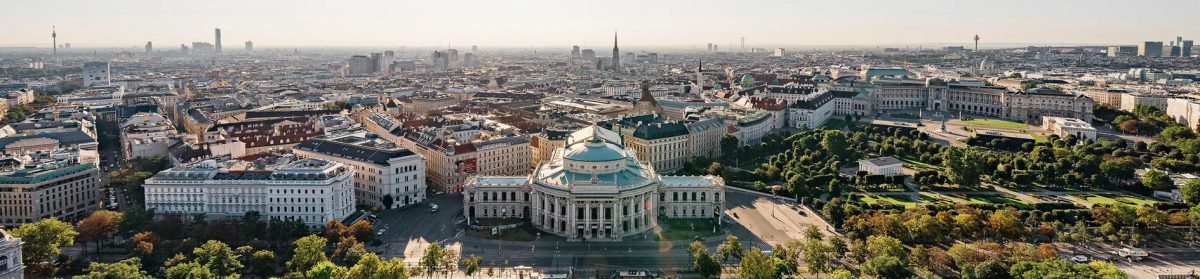
On the streets of Vienna

Philipp Broinger.

When I need to spend a few minutes in Vienna (which is more often than I like to admit), I just pull out my iPhone and look up the latest video from Philipp Broinger, who under the handle of architectphilipp roams the streets of Austria’s capitol to present Vienna’s unique architectural gems and offer anecdotes associated with those gems. Herr Broinger is a personable, likable chap, possessed of a seemingly encyclopedic knowledge about the city and delighted to be sharing it with others. His videos have garnered over 4,000 followers on TikTok and 25,000 followers on Instagram, and no wonder.

Below is one of Herr Broinger’s videos, about the history of music at the Stephansdom; he interviews the Stephansdom organist Konstantin Reymaier. You can follow architectphilipp at either of the TikTok or Instagram channels linked above, and he’s on Facebook too.

@architect.philipp

Exploring the soul of St. Stephen’s Cathedral, where history and music harmonize in every corner. From ancient organs to modern melodies, this cathedral has always been a place where sound fills the sacred space. Join me and cathedral organist Konstantin Reymaier on a journey through the cathedral’s rich musical heritage. Photocredits: Dombausekretariat St. Stephan, Wikipedia #stephansdom #wien #vienna #viennanow #architecturelovers #historylovers #organmusic

♬ Originalton – architect.philipp

Last years

Egon Schiele, Sitzende Frau mit hochgezogenem Knie, 1917. © Národní Galerie, Prag. Photo: National Gallery Prague 2024.

Opening tomorrow, March 28, at Vienna’s Leopold Museum, Egon Schiele: Last Years provides a comprehensive overview of Schiele’s work from 1914-1918 — the First World War — following the radically aggressive and discordant work of his earlier career. I’ve always been rather more fond of this late work; one of my favorite Schiele drawings, “Sitzende Frau mit hochgezogenem Knie,” dates from 1917. Unlike the early work, Schiele’s later art consists of rather less sensational landscapes and portraits, but to me they seem to exhibit a more compassionate perspective without sacrificing the sensuality of that early work: the erotics of the body shade into an erotics of the spirit.

The exhibition, per the Leopold Museum’s web site,

weaves together biographical and artistic elements, focusing on the ruptures and transformations in Egon Schiele’s “late works” from 1914 to 1918, a period that has received comparatively little attention until now. During this time, Schiele gradually abandoned the radical formal experiments of 1910 to 1914 and developed a more realistic style characterized by deeper empathy. His linework became calmer, more fluid, and organic, and the figures he depicted gained greater physical fullness. The exhibition also offers new insights into this pivotal period by incorporating contemporary archival materials, such as the previously unpublished diary of Edith Schiele.

The exhibition runs through July 13. There is a digital exhibition here, and the catalogue is available here. A short teaser trailer is below.

My five minutes and 25 seconds of fame

A special birthday gift this past weekend was a shout-out from radio klassik Stephansdom, and needless to say I was flattered and honored. They were also kind enough to accommodate my request for Scott Joplin’s “Reflection Rag” from my wife’s Syncopated Musings CD of a few years back. A tip of my hat, then, to Ursula Magnes, Christoph Wellner, and the rest of the gang at rkS. You can hear both their kind words and the music below.