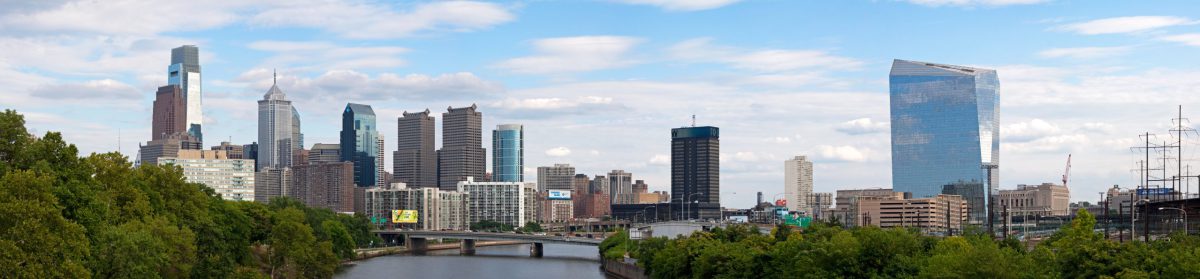
Down memory lane to the corner of 13th and Pine

All cities have their landmark bars — in New York they might include McSorley’s and the Cedar Tavern, for example, not to mention Pfaff’s; the latter two are with us no more — but unquestionably one of Philadelphia’s is Dirty Frank’s. We’ll be taking the kids down to Philly sometime in the next few weeks, and if we manage to swing by Frank’s, I’ll be introducing the third generation of the Hunka family to this cash-only watering hole.

My father first started going there in the 1950s, I believe, about twenty years after its opening on November 8, 1933, in the wake of Prohibition. In the 1950s, as in the 1980s when I spent countless evenings and much of my salary at Frank’s, the bar was a vibrant heterogenous mix of humanity. This was largely due to its location. Frank’s had been located just around the corner from the offices and presses of the Philadelphia Evening Bulletin at 13th and Filbert Streets, though by the time I started frequenting the bar the paper had closed. (I myself worked for a Philadelphia legal newspaper at the time, but alas never managed to join the nearby private Pen & Pencil Club, an omission I’ll always regret.) But this didn’t stop the many newspaper writers from gathering regularly at Frank’s; many were the times I saw Philadelphia Daily News columnist and later acclaimed novelist Pete Dexter nursing a club soda at the end of the bar, or Clark DeLeon collecting anecdotes and stories for his regular column in the Philadelphia Inquirer. Frank’s was just around the corner as well from the University of the Arts, so in those days it also attracted its share of budget-conscious painters, sculptors, and others. In fact, it still does; the north wall of the bar is an informal “Off the Wall Gallery” featuring the work of students and local artists. A few years ago Drew Lazor described the multi-ethnic, multi-cultural, multi-everything clientele of Dirty Frank’s in Vice:

In truth, Frank’s has always had a “type,” but the profile was not built using banal criteria like sex, race, religion, education or income. It instead takes a shine to individuals who can’t be neatly filed into the natural order, and don’t wish to be — a “crossroads for errant individualists,” as the Philadelphia Inquirer put it in 1982. … “Dirty Frank’s is an American melting pot with drinks,” the Inquirer wrote in 1973. “Its clientele includes sanitation workers, lawyers, students, dropouts from virtually anything, artists, clerks, poets, reporters, straights and occasional gays, blacks and whites, adventurous post-teeny boppers from the Northeast and a beloved old man who always wears a blue beret.”

During my time there the bar was occasionally closed down by the health department; it was a dive bar, after all. Then as now there was a Pennsylvania law that all bars serving alcohol also had to serve food; Frank’s tried to get around it by keeping a can of tuna, and a can opener, behind the bar to display to any visiting liquor board inspectors. (It didn’t work.) At some point in the distant past, a sign above the bar offered “MEATBALLS” as a menu item, but more recently some wag had vandalized the sign to read “RATBALLS.” I lived just across the street from Frank’s, and on one occasion the manager asked to borrow my vacuum cleaner to tidy up before a health inspector’s visit. And, of course, the men’s room urinal was kept constantly stocked with ice cubes to keep any noxious aromas from creeping too far into the main room.

I don’t want to go more deeply into my own history; the history of the bar speaks for itself, anyway; Dennis Carlisle has a more comprehensive narrative of Dirty Frank’s at Hidden City Philadelphia.

For me, most of Frank’s appeal (apart from its low prices) was that it was a “melting pot with drinks” — Frank’s welcomed a panoply of individuals from all walks of life, urging them to relax, to drink, and to talk — especially to talk, to share anecdotes and observations, and just as importantly to listen. (And, I should note, laugh — for all the virtues of Frank’s jukebox, it came in a distant third after talk and laughter as elements of Frank’s soundscape.) Those who sat at Frank’s bar and at the tables surrounding it disdained one’s identification with one’s own cultural group and valued, more than anything else, individuals and their contributions to the communal dialogue. That it was located in Philadelphia is revealing: as Peter Thompson noted in his book Rum Punch and Revolution, Philadelphia taverns were where American democracy was first hammered out in the colonial era. Through all of Dirty Frank’s existence, its drinkers and talkers reflected the spectrum of human experience and demonstrated that, at least at the bar, it was possible for a wildly diverse community to find liberty and freedom in talk and conversation and laughter: in one small way, a dream of America itself.

A toast to Mineshaft

In many ways, I’m still an analog boy in a digital world, and when it comes to leisure material for reading, watching, and listening, I prefer the hand-made sort of entertainment, whether it’s mid-budget comedy movies from the 1930s or what’s generally become known as roots music. Books and magazines that suit my temperament are harder to come by these days, though.

Fortunately there’s still Mineshaft magazine, celebrating its 20th anniversary this year. Inspired by underground magazines and comics of the past, Mineshaft is a modest and resolutely hand-crafted periodical that’s issued about three times a year, published by Everett Rand and Gioia Palmieri in Durham, NC, far from the media meccas of New York and Los Angeles. Produced through the increasingly quaint offset printing method, the magazine’s prose, poems, and comics are resolutely free of cant and pretension. The Spring 2019 issue (No. 37) features recent work from veteran cartoonists and illustrators Drew Friedman (front cover), R. Crumb (back cover), Art Spiegelman, Bill Griffith, and Mary Fleener; poems and paintings by Billy Childish; and work by a number of artists who are unknown to me, such as Nicolas C. Grey, David Collier, and Noah Van Sciver. What they all share is a rootedness in the physical, not the digital, world; like the magazine, the work has a distinctively handmade quality, and the comics especially share a meditative and contemplative marriage of laconic prose and atmospheric inkwork pioneered by, among others, Harvey Pekar in the 1970s. There’s a melancholy that hangs over the whole, a feeling that the analog world it depicts is being lost, if it hasn’t been lost already. That the work has a particularly satiric quality, then, doesn’t come as much of a surprise, especially when it refers to the digital realm, and it’s not much of a shock to find, tipped in with this contemporary work, a reproduction of a detail from a painting by William Hogarth.

Both single issues of No. 37 and back issues are still available from the Mineshaft web site, and you can pony up for a subscription there as well. Obviously the magazine, itself a beautifully, lovingly produced object, will be an acquired taste for those who have drunk deep from the well of the internet culture; it’s not for everybody. But it is, in many ways, for me.

Hide and seek

The idea of ruins — archaeological, architectural, cultural, even psychological — lies at the center of Philadelphia: Finding the Hidden City, published in November 2017 by Temple University Press; it’s a philosophical meditation masquerading as a coffee table book.

A handsome book it is, too. Photographer Joseph E.B. Elliott provides contemplative perspectives on a variety of public, semi-public, and commercial spaces in Philadelphia, many of them off-limits to the casual flâneur in the City of Brotherly Love; the accompanying text, by Nathaniel Popkin and Peter Woodall, eschews a straightforwardly historical approach by considering the relationships between these spaces, their history, and their current uses and disuses.

Most books of Philadelphia history like this, boasting glamorous and unpeopled photographs of interiors and restored exteriors, concentrate on the colonial and early national eras of the 18th and early 19th century. The Hidden City authors turn their attention instead to the later 19th and early 20th centuries, finding the objects of their contemplation in churches both formal and informal; sewers and abandoned subway stations; municipal buildings, some like Philadelphia’s City Hall still abuzz with activity and some like Germantown’s  Town Hall in disuse; and prisons like Eastern State and Graterford, designed on the long-abandoned idea of the panopticon as a means of moral punishment.

The “ruin” in this book, though, is considered less as an attractive fragment than as a living object with a life of its own. “For Philadelphia seems to possess an exceptionally large number of places that have disappeared elsewhere — workshops and small factories, sporting clubs and societies, synagogues and theaters and railroad lines — like endangered species that have managed to stay alive in some remote forest or swamp,” Popkin and Woodall muse. Among the more telling passages are a visit to the remains of the International Peace Movement community that Bible-thumper Father Divine founded, along with the Divine Lorraine Hotel on North Broad Street; the Church of the Gesú, site of a depressing and violent civil rights controversy in the 1940s; and a peek into the John Stortz and Son tool factory, founded in 1853 in Philadelphia’s Old City and, somewhat miraculously in this day and age, still flourishing and providing employment to machine workers and small craftsmen. An additional pleasure of the book is a long-overdue consideration of the monumental contributions that people of color and women made to the economic and cultural life of the city over the past 150 years.

As Philadelphia: Finding the Hidden City peels back the layers of the past, it reveals more than ruins of buildings; it also reveals the ruins of certain habits of mind, of shared community values, reminders of the stresses and anxieties that made and continue to make Philadelphia a unique place in the world. Film directors like Terry Gilliam and David Lynch turned some of these same settings into nightmares, but that didn’t do them justice. The book gives them a new and glowing life. Every city has a different flavor, hard to define precisely and, because cities are always changing, always provisional. Philadelphia: Finding the Hidden City is an essential bridge between past and present. Sure, it belongs on your coffee table. But make sure to read it, too.

NOTE: The book is the product of the ongoing Hidden City Philadelphia project; you can find its website here.