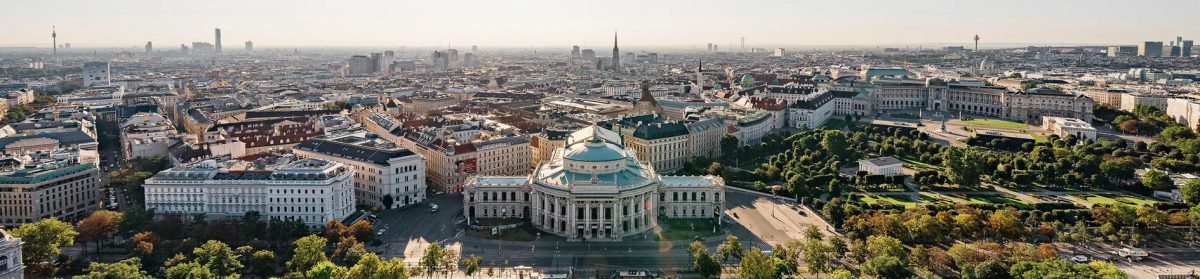
When I need to spend a few minutes in Vienna (which is more often than I like to admit), I just pull out my iPhone and look up the latest video from Philipp Broinger, who under the handle of architectphilipp roams the streets of Austria’s capitol to present Vienna’s unique architectural gems and offer anecdotes associated with those gems. Herr Broinger is a personable, likable chap, possessed of a seemingly encyclopedic knowledge about the city and delighted to be sharing it with others. His videos have garnered over 4,000 followers on TikTok and 25,000 followers on Instagram, and no wonder.
Below is one of Herr Broinger’s videos, about the history of music at the Stephansdom; he interviews the Stephansdom organist Konstantin Reymaier. You can follow architectphilipp at either of the TikTok or Instagram channels linked above, and he’s on Facebook too.
Exploring the soul of St. Stephen’s Cathedral, where history and music harmonize in every corner. From ancient organs to modern melodies, this cathedral has always been a place where sound fills the sacred space. Join me and cathedral organist Konstantin Reymaier on a journey through the cathedral’s rich musical heritage. Photocredits: Dombausekretariat St. Stephan, Wikipedia #stephansdom#wien#vienna#viennanow#architecturelovers#historylovers#organmusic
The week ends on a moderately high note: the Eagles won their first game of the 2025-2026 season last night, so a little cautious optimism is in order. You still have a few days to hear the Philadelphia Orchestra’s concert production of Tristan und Isolde. And a reminder that Pursuit, the new podcast series from the National Constitution Center, premieres next week.
If you find this a good weekend to cuddle up with a little British TV, you can start it off with the new season of The Great British Baking Show, which launches its new season on Netflix today. Also, I’ve come a little late in the game to Slow Horses, the spy drama which premiered on Apple TV a few years ago, but I highly recommend it. Gary Oldman plays Jackson Lamb, a cynical, flatulent, foul-mouthed, and very likely alcoholic version of George Smiley who oversees a bunch of MI5 agents; they’ve badly screwed up intelligence operations in one way or another and find themselves languishing in a shabby London outpost of the intelligence service. (Oldman has played Smiley, too, in the 2011 film of Tinker Tailor Soldier Spy, and he received an Oscar nomination for his performance.)
It’s a well-constructed and fast-moving thriller that enjoys delving into the eccentricities of its characters, not to mention dropping a few shards of social and cultural criticism along the way; it’s won some awards here and there, and Oldman himself has been nominated for an Outstanding Acting Emmy this year (it’s also been nominated for Outstanding Drama Series, as well as Writing and Directing nods). As Lamb describes the men and women under his supervision, “I think they’re a bunch of fucking losers. But they’re my losers.” My kind of spymaster.
The Super Bowl winners the Philadelphia Eagles will open its 2025 season tonight hosting the Dallas Cowboys at the Linc, so it seems only appropriate that I repost the below note, which was first published here on the eve of the 2025 Super Bowl. As far as the Phillies go — well, I hope they don’t blow it this time.
When I was in Philadelphia late last year, preparing a move back to my hometown in the not-too-distant future, I was settling up my bill at the club, and just as I said my goodbye to Shannon, the bartender, she nodded at me and said, “Go Birds” — with a somewhat cynical, flat affect, a tone that’s not uncommon to Philadelphians. I hadn’t heard the phrase before (I hadn’t been in the city for quite some time), and sensing my confusion, she said, “It’s something we say to each other here, George. Go Birds. You’ll get used to it.”
Now that the Eagles have a good shot at the Super Bowl again — after having won in 2018 and lost in 2023 — I’m putting on my Eagles cap. As a native-born Philadelphian, I have an obligation to do so, though I’m more of a baseball than a football fan myself. (The post-season performance of the Phillies last year was a nightmare from which I’m still trying to awake.) More than any enthusiasm for the game, I’m loyal to a city that takes its sports teams very seriously, even if on occasion its sports teams and their corporate owners treat their fans reprehensibly.
The phrase has transcended its original purpose as an expression of fandom and become — well, become a sign of affection, especially for the city itself. In 2023, shortly after the Eagles lost the Super Bowl, Philadelphian Hannah Workman wrote:
Even though the Phillies just lost the World Series and the Eagles just lost the Super Bowl, I still have hope for the remaining Philadelphia teams. Losing those championships after being underdogs and making it to the finals was something that really captured the “essence” of Philadelphia. … Philadelphians and anyone who roots for Philly sports teams have a special connection, and seeing it come to life while away from family at college has been so special. I may miss home, but when I hear the phrase, “Go Birds,” I don’t feel quite as alone.
Even non-Philadelphians appreciate the feeling. “I don’t have any specific issue with Philadelphia as a city, but the general animosity I feel towards Philly sports fans and their … passionate reputation tends to color the city as a whole for me,” Ned Donovan wrote a few days ago on Medium. He continues:
It’s fascinating, then, how language and colloquialisms can evolve beyond their original meaning. “Go Birds” isn’t just a rally cry for a football team — it’s a Philadelphia love language. It’s a way of saying “I see you, I acknowledge you, we’re in this together.” In a city known for its hardened exterior, these two words serve as a handshake of solidarity, a gentle reminder that beneath the tough facade beats a heart of gold.
“I still don’t like Philadelphia. Probably never will,” Donovan concludes. Of course, former Eagles center Jason Kelce’s “No one likes us and we don’t care” is the only reasonable response to such a sentiment:
So yeah, I’ll be watching the Eagles take on the Washington Commanders next Sunday. Go Birds? Goddamn right, Go Birds.
I’m delighted to hear, therefore, that Philadelphia’s National Constitution Center will launch a podcast series based on Mr. Rosen’s book next week. Per its web site:
Pursuit: The Founders’ Guide to Happiness is a 12-part series hosted by Jeffrey Rosen featuring Ken Burns and leading scholars. It explores how the founders understood personal growth as essential to the common good, and how you can put those ideas into practice today.
I wrote and published the below — along with its concluding popcult legerdemain — on July 3, 2024.
Every year around this time I try to honor the season by unsuccessfully pestering my wife and children to watch 1776 with me (they can’t be blamed for my failure, I suppose; all that prancing around to ersatz Gilbert and Sullivan, in the guise of a history lesson no less, brings even the most forgiving audience crying to its knees) and reading something that pertains to the historical significance of the moment. I’m about halfway through The Pursuit of Happiness: How Classical Writers on Virtue Inspired the Lives of the Founders and Defined America by Jeffrey Rosen, a constitutional lawyer and the president of Philadelphia’s National Constitution Center, a book that I plan to unsuccessfully pester my wife and children to read.
The subtitle is well-descriptive of the book, which studies the role that classical virtues of Greek and Roman philosophers played in the education, thinking, and actions of the Founders — virtues such as order, temperance, humility, industry, frugality, sincerity, resolution, moderation, tranquility, cleanliness, justice, and silence. Many of the Founders, like Jefferson, Franklin, and Adams, repeatedly cited these virtues and especially Cicero in their writings and thinking, and they wormed their way into the Declaration of Independence and the US Constitution as well. Although they held themselves to these high standards, the Founders frequently usually failed to meet those standards (their failure was most spectacularly miserable when it came to slavery), but it was the attempt to better themselves — to pursue “happiness” as it was defined during the Enlightenment, rather than the “happiness” as it’s defined in these more hedonistic days — that provided them with insights into democracy and republicanism.
As I say, I’m about midway through and am loathe to say more about it before I’m finished, but it did cater to my curiosity about the role that architecture and physical surroundings play in the way we think about ourselves and our world. In the early and mid eighteenth century, Philadelphia’s architects embraced the Georgian style of order, proportion, and restraint: even today, the buildings around Independence Mall in Philadelphia remain experienced on a human scale, and the orderly, practical rowhouses and trinities of Olde City and Elfreth’s Alley too seem appropriate to a cozy comfortability.
These were the buildings that the Founders lived and worked in and ate and drank at as they debated the foundational documents of the United States. Even today we can walk in their footsteps and admire the same Georgian order, proportion, and restraint. Alas, the style was not to last — architects around the turn of the century embraced the Federal and Greek Revival styles that led to buildings like the First Bank of the United States a few blocks away from Independence Hall. It appeared as if they were trying to live up to Philadelphia’s reputation as the “Athens of America,” and they were going to have the buildings to prove it, goddammit.
Twilight of the gods? The Greek Revival First Bank of the United States in Philadelphia, built in 1797. Photo: National Park Service.
Although it’s a bit of a left-field stretch, there’s another sense in which The Pursuit of Happiness is relevant to today’s Philadelphia. Rob McElhenney’s comedy It’s Always Sunny in Philadelphia is in many ways Pursuit‘s counter-text. Instead of cultivating the classical virtues of order, temperance, humility, industry, frugality, sincerity, resolution, moderation, tranquility, cleanliness, justice, and silence, the reprobates who frequent Paddy’s Pub in South Philadelphia cultivate the classical vices of disorder, crapulence, narcissism, sloth, extravagance, perfidy, half-heartedness, extremism, chaos, filth, bigotry, and noise. This provides a fertile ground for the show’s frequent satiric forays into politics and culture: Mac, Charlie, Frank, Dennis, and Sweet Dee confront issues like abortion, racism, sexual identity, drug addiction, urban blight, gun control, the MeToo movement, political corruption, and welfare by indulging in these vices without apology, self-control, or self-knowledge, often destroying property and the lives of innocents in the process.
I’m not sure that IASIP can really bear all the weight that I’m putting on it — the show is a gross-out comedy first and foremost, after all. But the show depicts what happens to people and politics when the classical virtues are ignored and the irrational id instead of reason and restraint is given free rein to trample over the rights of others. While the show’s setting in Philadelphia is in part an accident of chance — McElhenney is a Philadelphia native, and the show’s B-roll of Philadelphia locations is affectionate and lovingly knowledgeable — the gang traipses through the same streets as the Founders, an unintended comment on just how far we’ve fallen in the 248 years that have separated them. But if you want to see how we started, read The Pursuit of Happiness; to see where we ended up, watch It’s Always Sunny in Philadelphia.
However you celebrate Independence Day and America’s 248th birthday tomorrow, I hope you make it a good one.
Nina Stemme sings while Yannick Nézet-Séguin conducts The Philadelphia Orchestra in a production of Tristan und Isolde at Marian Anderson Hall on June 1, 2025. Photo: Jessica Griffin/The Philadelphia Orchestra.
It’s really too good not to share: you can now hear (until September 13) the recent concert performance of Wagner’s Tristan und Isolde from The Philadelphia Orchestra under the baton of Yannick Nézet-Séguin, featuring Nina Stemme’s final performance as Wagner’s doomed heroine, recorded live on June 1 of this year. WRTI notes that Wagner’s opera has had a long history with the Philadelphia Orchestra, having presented the first full performance of Tristan und Isolde in the United States 90 years ago. Melinda Whiting has more at the WRTI web site, where you can access the recording.
Now that summer is past, I’m hoping to post here more regularly: specifically about Philadelphia, my home town. I miss it, and hope to get there more. You can read more about my long personal relationship with Philadelphia in these blog posts. Feel free to let me know what you think.