Lichtspiel

Regular readers expecting frequent reports of my profound insights have I’m afraid been disappointed over the past month; life does get away from one, doesn’t it? I still plan to write more about my very meaningful journey to Vienna in March, but I am also still thinking about it and trying to find a good structure for the writing. I think I’ve found it and I hope to get to it soon. At any rate, apologies to all, and I still think fondly of my new friends in Austria.

In the meantime I can recommend The Director, the new novel by Daniel Kehlmann and shortlisted for this year’s International Booker Prize. Lichtspiel, to give it its original German, Paul Celanian title, follows the great Austrian film director G.W. Pabst (1885-1967) from a brief exile in Hollywood in the 1930s through his return to Central Europe in 1939 with his wife and son (a fictional invention) to visit his ailing mother. He finds himself trapped through the war years and decides to work for the Third Reich, on films which he insists do not contribute to Nazi propaganda. The novel is a keen and often funny — not to mention timely — exploration of compromise and the artistic spirit (in one episode, Pabst acts as a co-director of a film by the spiky Leni Riefenstahl — yes, this film; in another, we’re treated to P.G. Wodehouse’s attendance at the Berlin premiere of Pabst’s Paracelsus in 1943), and I highly recommend it.

Opernachmittag

I couldn’t let the day go by without noting that tomorrow’s Metropolitan Opera broadcast will feature the new Met production of Richard Wagner’s Tristan und Isolde, featuring Lise Davidsen and Michael Spyres; Yuval Sharon directs and Yannick Nézet-Séguin conducts. You can stream this via Philadelphia’s WRTI tomorrow afternoon, March 21, at 12:00 noon Eastern time.

The New York Times‘ Josh Barone was enthusiastic about the new production earlier this month — “the event of the season,” he says (gift link to his review here) — and it will undoubtedly be worth the time. Davidsen is reputed to be nothing less than miraculous (director Sharon has given her a baby in this one; I’m thinking I’ll be glad to listen and not sorry to miss the visuals), and Nézet-Séguin conducted a terrific in-concert version with Nina Stimme last season. I confess I’m somewhat skeptical of director-centric productions by the likes of Sharon; on the other hand, I was spellbound by the Chereau Ring at Bayreuth and recently very much enjoyed Barrie Kosky’s Don Giovanni for the Vienna opera. The little I’ve read of Sharon’s A New Philosophy of Opera is intriguing and tempts me to read further — what do I know? Still, a baby?

Event of the season or not, Tristan is one of the great achievements of the aesthetic imagination, an extraordinarily erotic and meditative work, Schopenhauer as music. Listen, and before a second listening read Bryan Magee’s The Tristan Chord.

Quasquicentennial

Or, to be rather less threatening about it, the Philadelphia Orchestra is celebrating its 125th anniversary this year. The orchestra is very closely associated with the historic Academy of Music, which is where I saw them in my youth, and my first visit to the Kimmel Center last year suggested that the new hall is fully worthy of the orchestra, acoustically and architecturally.

Enthusiasts for the orchestra can tune into WRTI this Sunday at 1:00 pm Eastern for the start of a special two-week celebration, “examining the evolution of ‘the Philadelphia Sound’ through the performances and comments of the conductors who have nurtured it,” as WRTI host Melinda Whiting at this web page has it. Sunday’s program begins with the earliest years of the orchestra under Leopold Stokowski and carries through to the orchestra under Eugene Ormandy and Riccardo Muti; next week the celebration picks up with a look at the orchestra under Wolfgang Sawallisch, Christoph Eschenbach,  and its current music and artistic director Yannick Nézet-Séguin.

You can livestream WRTI’s programming directly from its home page. For a little more context, look up Bruce Hodges’ insightful introduction to the Philadelphia Sound, which reveals that it’s about more than the string section.

Auf wiedersehen, Wien

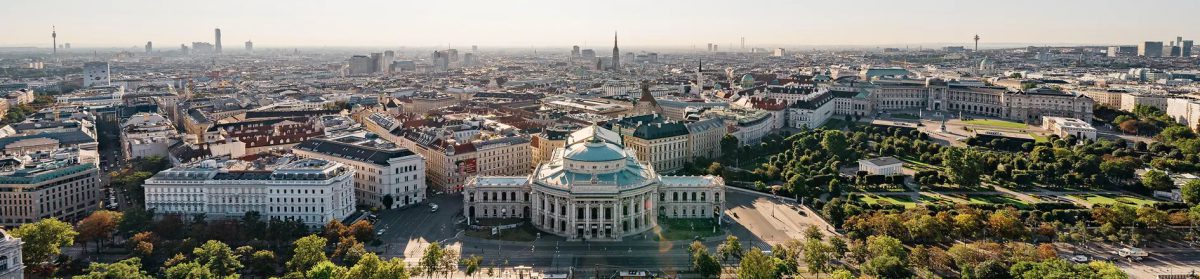
Bernardo Bellotto: View of Vienna from the Belvedere, 1759–1760.

I’ve just returned from a meaningful week-long journey to Vienna, and especially memorable was the generous hospitality I enjoyed from the utterly charming Arabella Fenyves and the most gracious Christoph Wellner at radio klassik Stephansdom, then a few days later from the gentlemanly John Haynes over a few glasses of wine at the Cafe Schopenhauer. This, along with a fine and meditative St. John’s Passion at the Stephansdom itself; visits to the Belvedere, the city museum (excellent, I must say), the Leopold Museum and the Peterskirche; and Sunday mass at the Hofmusikkapelle on my birthday made for a very special week. When I first visited Vienna many years ago, I was most intrigued by the city’s fin de siècle culture; now, it seems, I’ve gone fully Baroque. I make no apologies for this, though of course I’ll never abandon Schnitzler, Klimt and Schiele (not to mention Thomas Bernhard). One day I’ll write all this up.

One exhibit that I will miss, however, will be the Canaletto & Bellotto exhibition opening at the Kunsthistorisches Museum later this month. The painting at the top of this post will undoubtedly be front and center of the exhibition; the Museum web site notes:

The panoramic view looks north from the Upper Belvedere, the summer palace built for Prince Eugene of Savoy but purchased in 1752 by Empress Maria Theresia. The city unfolds as a sequence of monumental landmarks. Bellotto seems to render Vienna with near-cartographic precision, but subtly compresses distances and steepens towers to guide the viewer’s eye inward and upward. The result is a carefully constructed image of Imperial order, presenting Vienna as flourishing under the rule of Maria Theresa and Francis I Stephen.

Having just enjoyed that view myself from the Upper Belvedere, I can report that the charm of the landscape is undimmed after 250 years. Thank you especially to my lovely wife for the opportunity. Arabella, Christoph and John: I’ll be back.

Opernabend: Trouble at the mill

Tomorrow’s opera from radio klassik Stephansdom is Eugen D’Albert’s Tiefland, which premiered in Prague in 1903. A verismo opera nodding, as the genre does, towards a gritty realism, Tiefland is largely set in a village mill and is described in MusicWeb International as follows:

Tiefland tells the story of Marta, a poor young woman who is the mistress of the local landowner Lord Sebastiano. Sebastiano has money troubles, so is about to marry an heiress, and thus needs to expunge the local notoriety associated with keeping a mistress. He plans to have Marta marry his naïve shepherd Pedro, so that she can live nearby and still serve as his mistress. However, his plan fails when Marta and Pedro actually fall in love, and Sebastiano’s manipulation is revealed. The opera ends in a physical struggle in which Pedro strangles Sebastiano, and then escapes with Marta up into his beloved mountains, and away from the corrupting lowlands.

D’Albert, a noted pianist, was born in Glasgow in 1864 but emigrated to Germany, where he was a student of Franz Liszt. He wrote 21 operas, and his romantic history seems just as prolific as his musical career: he was married six times and died in Riga in 1932, where he was pursuing a divorce from his sixth wife. Tiefland also has the dubious distinction of being the only opera to be adopted to film by Leni Riefenstahl. Says the Wikipedia page for the opera: “The best-known film adaptation of the opera was by the German director Leni Riefenstahl, with Riefenstahl herself playing Marta. The film, begun in 1940, but not released until 1954, used Roma slave labor from a German transportation camp for some of the extras, many of whom were sent to Auschwitz before the end of the war.”

So: a true curiosity, more produced today in Europe than in the United States, and not often there. radio klassik Stephansdom will broadcast a 2002 recording of the opera, with the ÖRF Radio Symphonie Orchester Wien conducted by Bertrand de Billy. You can hear it tomorrow, February 23, at 2:00 pm Eastern time here.