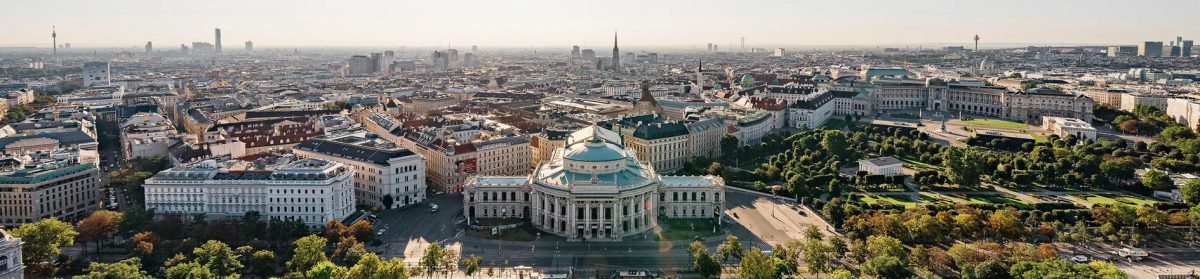
As long as we’re on the subject of magazines, I tip my hat to the newly-redesigned magazin Klassik from my favorite radio station, radio klassik Stephansdom. It’s a dynamic publication from Vienna, now celebrating its tenth year, and its design has always been a delight to the eye; now, it’s even more delightful.
“This exclusive magazine features program previews and recaps, provides in-depth reports and articles on art, literature, and science, offers reviews and opinions, and highlights exciting cultural events,” says the station, and for those of us learning German it’s a great educational tool as well. (And the new issue also salutes yours truly, who enjoyed the kind generosity of lovely and talented host Arabella Fenyves and tireless and handsome general manager Christoph Wellner on a visit to the station in March.)
You can download the new issue and stream the station itself here. And as long as you’re there, don’t forget to donate to keep radio klassik Stephansdom going: it’s a rare treat.
I’ve just about completed my move to Philadelphia and am gearing up to writing again here just after Labor Day.
My books and music are just about unpacked. With every move my library becomes smaller and smaller as a practical matter, but the process does tend to focus the attention on what I’ll be dragging with me into my retirement years. And it provides insight into what affinities and ideas have stayed with me all this time. There is, of course, Vienna:
Arthur Schopenhauer and Richard Wagner have earned a place of honor:
And apparently German and Austrian literature have been saved from the local used book store, along with a growing collection of language textbooks:
Finally I’m just about ready to spend my time on a writing project about Vienna. But before that, there’s one child to get to college, another to a new high school, and myself to a more orderly daily routine. I haven’t forgotten my friends, so you’ll hear more from me soon.
When the Bayreuth Festival opens tomorrow for its 150th season, it will open with a work never presented there before: Richard Wagner’s Rienzi, his third opera, which premiered in Dresden in 1842 and was for many years his most popular opera in Europe (to his considerable chagrin later in life; indeed, he himself barred any production of it at the Festival during his lifetime). Its plot, per Wikipedia:
The opera is set in Rome and is based on the life of Cola di Rienzo (1313–1354), a late medieval Italian populist figure who succeeds in outwitting and then defeating the nobles and their followers and in raising the power of the people. Magnanimous at first, he is forced by events to crush the nobles’ rebellion against the people’s power, but popular opinion changes and even the Church, which had urged him to assert himself, turns against him. In the end the populace burns the Capitol, in which Rienzi and a few adherents have made a last stand.
Rarely performed, the curtain rises in Bayreuth tomorrow, July 26, at 4:00 pm local time. Wagnerians of the United States, however, can turn to Deutsche Grammophone’s Stage+ service to watch it live tomorrow at 10:00 am Eastern time, with repeats at 6:00 pm tomorrow night and 5:00 am on Monday morning. (A Vienna friend offers a few more options.) The production is directed by Alexandra Szemerédy and Magdolna Parditka, while Nathalie Stutzmann takes the podium.
One of the most moving moments of my last trip to Vienna was my attendance at Mass at the Wiener Hofmusikkapelle on my birthday, where Caldara’s Missa Dolorosa was on the program. So I’m delighted to report that radio klassik Stephansdom‘s music director Ursula Magnes, with whom I had the delight of exchanging a few pleasantries about Heinrich Schütz last year, has been named the new director of the Hofmusikkapelle, beginning on September 1. This is the first time a woman has been named director to the post. Rector Peter Schipka said, “As rector of the Hofburgkapelle and thus as the ecclesiastical responsible for the services in this place, I congratulate Mrs. Ursula Magnes very warmly on her appointment as director of the Hofmusikkapelle, as the first woman in this function. I am delighted by her appointment and look forward to working with her.” I congratulate her too, for what it’s worth; the Hofmusikkapelle is in good hands.
I’ve never made a secret of my enthusiasm for the Neue Sachlichkeit/New Objectivity genre of early 20th century art, but until now my exposure has been limited to artists of Germany, such as George Grosz and Christian Schad. On my recent visit to Vienna I came across a few samples of the Austrian branch of this art, but alas, English-language material on these paintings and sculptures has been meagre.
If someone would care to put up the money for another trip to Vienna, I’d thank them for allowing me to visit PREMIERE!: The Oesterreichische Nationalbank Collection, running through October 11 at the Leopold Museum, which features a terrific selection of Austrian Neue Sachlichkeit, early 20th century geometrical and gestural abstraction, and figurative work. Franz Sedlacek’s painting at the head of this post is unsettling in a way that the German New Objectivists only sometimes achieve. According to the Leopold web site,
As a representative of Magical Realism, Sedlacek is often dubbed a “mystic of New Objectivity”. Working as a chemical scientist, the self-taught artist devoted his evenings to experimenting with painting, creating uncanny depictions. The effect of spatial depth, similar to that of a peep box, offers viewers the opportunity to delve into another world and to witness a surreal scene: Coziness gives way to trepidation, the apparently familiar becomes absurd.
As it is, I will have to settle for the digital exhibition of PREMIERE!, which as fine as it is leaves one hungry for more. I hope a few of my new Austrian friends will visit the exhibition and report back. In the meantime, I can dream.
Regular readers expecting frequent reports of my profound insights have I’m afraid been disappointed over the past month; life does get away from one, doesn’t it? I still plan to write more about my very meaningful journey to Vienna in March, but I am also still thinking about it and trying to find a good structure for the writing. I think I’ve found it and I hope to get to it soon. At any rate, apologies to all, and I still think fondly of my new friends in Austria.
In the meantime I can recommend The Director, the new novel by Daniel Kehlmann and shortlisted for this year’s International Booker Prize. Lichtspiel, to give it its original German, Paul Celanian title, follows the great Austrian film director G.W. Pabst (1885-1967) from a brief exile in Hollywood in the 1930s through his return to Central Europe in 1939 with his wife and son (a fictional invention) to visit his ailing mother. He finds himself trapped through the war years and decides to work for the Third Reich, on films which he insists do not contribute to Nazi propaganda. The novel is a keen and often funny — not to mention timely — exploration of compromise and the artistic spirit (in one episode, Pabst acts as a co-director of a film by the spiky Leni Riefenstahl — yes, this film; in another, we’re treated to P.G. Wodehouse’s attendance at the Berlin premiere of Pabst’s Paracelsus in 1943), and I highly recommend it.