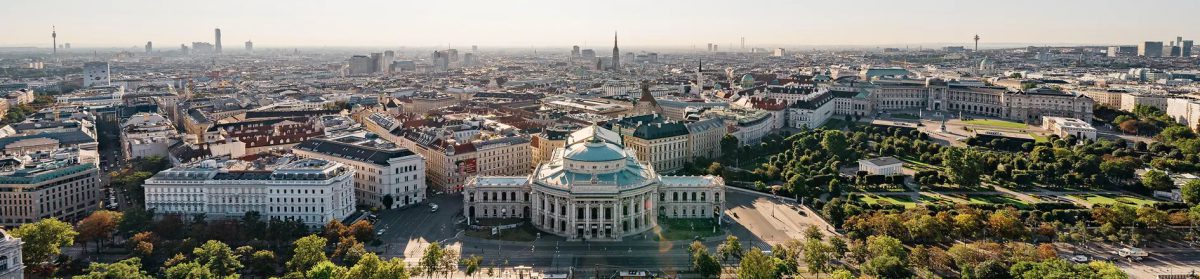

Of all of the many books about Vienna, few survey its history from its foundation in the second century after Christ, when Emperor Marcus Aurelius was headquartered in Vindobona, a Roman military camp underlying what is now Vienna’s 1st district, finishing up his book of meditations; he died there in 180 CE. But there are two of them. The best remains Ilsa Barea‘s 1966 Vienna: Legend and Reality, published by Knopf. Barea was born in Vienna in 1902 and died in the same city in 1973, after a career that included journalism, fighting on the Republican side in the Spanish Civil War, and participating in a variety of communist and anti-fascist activities. A polyglot, she spoke five languages and received a law degree from the University of Vienna in 1928. The second of the two books, for those who are interested, is Nicholas Parsons’ fine 2008 Vienna: A Cultural History, which owes quite a bit to Barea’s work; he called it “a kind of love-hatred letter to the city that she had had to flee and captures the feelings of nostalgia tinged with melancholy.”
Barea’s book is beautifully written, also tinged (but only tinged) with her political opinions. She herself describes it as “a historical essay based on research … the sketch for a portrait … of an infinitely rich urban civilization.” Early on in the book she tries to provide in a nutshell the qualities of both the city and that civilization, and it’s worth quoting here:
What had made the Viennese what they were — and are? Here is the core of the matter, difficult of approach. At best it is possible to identify the main elements that went into the making: the fusion of ever shifting national groups in the urban melting-pot; the border fortress confronting the East, belonging to the West; the centuries-old tradition of living at the center of political storms, as on an island with precarious privileges; the anti-heroic object lessons of long-drawn battles of conscience throughout Reformation and Counter-Reformation; the disruption of a rising middle class on the verge of social, intellectual and economic expansion; the crippling of municipal freedoms, and in exchange a rich mess of pottage, the patronage of an international court; finally, the need of living one’s private life fully under the permanent pressure of external insecurity.
Many of these qualities remain visible in today’s Vienna. Perhaps even more evident is the physical conflict between tradition and modernity, a conflict that many who love the city have internalized, from Haydn through Beethoven to Schönberg in music, from Fischer von Erlach to Otto Wagner and Adolf Loos in architecture; the interior of the eleventh century Stephansdom now features work by contemporary artists. It’s a mere walking distance of ten minutes or so between the Peterskirche and the Klimt and Schiele exhibitions at the Leopold Museum. The city uneasily balances the sensuous erotic and the sensuous spiritual, the contemporary and the ancient, the godless and the priest, a balance that can also be internalized, as evidenced by its writers Schnitzler, Musil, Roth, and Bernhard. And, of course, hanging over the city is a more recent experience of madness and cruelty which the city has had difficulty accepting. Barea skillfully explores that tension between “legend and reality” in a mere 380 pages, though it must be said that the anatomy of that tension may deserve many volumes more.