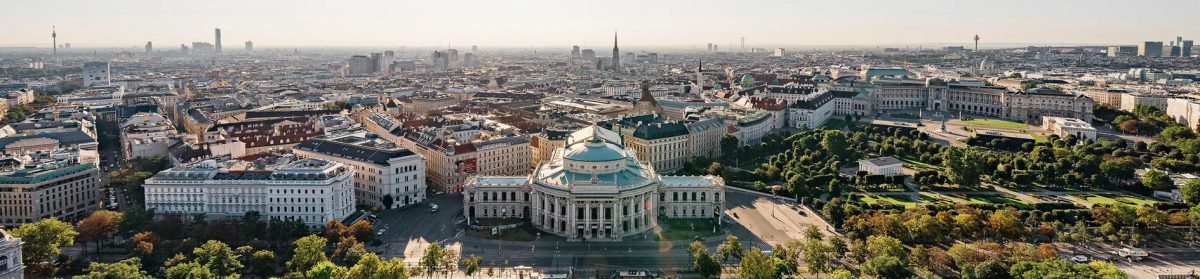
Radio klassik Stephansdom‘s November Spendentag will take place tomorrow, Tuesday, November 18, and this time around the theme is “Land of Sounds — Youth Edition,” celebrating the role that young people are playing in keeping the legacy of European and American art music hale and healthy. Several guests will be live in the Vienna studio, including representatives from the Vienna Boys’ and Girls’ Choirs and the Vienna State Opera School, along with special musical presentations. So tomorrow (or today — why wait?) open up those wallets and toss a few Euros Radio klassik Stephansdom’s way. More information about tomorrow’s Spendentag can be found here, and you can donate online here.
Of course donation drives have been a feature of public radio here in the United States for years (even the defunct and privately-held Philadelphia WFLN station, with which I grew up, was for many years listener-supported; the Philadelphia Inquirer reported on its 1997 closure here). With recent federal cuts to public broadcasting, though, every week has become pledge week, so along with Vienna’s fine classical music outlet I suggest you contribute as well to Philadelphia’s WRTI, maybe the closest thing Philadelphia has to radio klassik Stephansdom. WRTI has been looking to youth as well these days; I’m hoping to listen soon to a stream of Saturday’s broadcast of Mozart’s Così fan tutte, performed by students at Philly’s Academy of Vocal Arts. WRTI’s John T.K. Scherch has more on the production, and interviews with the cast, here. You can donate here, and I’ll add a link to the Così stream when and if it’s available.
Both stations’ web sites provide live streams of their broadcasts, but if you’re looking for something with a little more clarity and bandwidth, I recommend signing up for TuneIn and running it through your music streamer. Sounds great.
Nina Stemme sings while Yannick Nézet-Séguin conducts The Philadelphia Orchestra in a production of Tristan und Isolde at Marian Anderson Hall on June 1, 2025. Photo: Jessica Griffin/The Philadelphia Orchestra.
It’s really too good not to share: you can now hear (until September 13) the recent concert performance of Wagner’s Tristan und Isolde from The Philadelphia Orchestra under the baton of Yannick Nézet-Séguin, featuring Nina Stemme’s final performance as Wagner’s doomed heroine, recorded live on June 1 of this year. WRTI notes that Wagner’s opera has had a long history with the Philadelphia Orchestra, having presented the first full performance of Tristan und Isolde in the United States 90 years ago. Melinda Whiting has more at the WRTI web site, where you can access the recording.
Now that summer is past, I’m hoping to post here more regularly: specifically about Philadelphia, my home town. I miss it, and hope to get there more. You can read more about my long personal relationship with Philadelphia in these blog posts. Feel free to let me know what you think.
When I was a wee lad in short trousers, my father regularly took my brother and me to the Sunday afternoon Philadelphia Orchestra matinees at the Academy of Music. At that time, I caught the tail end of Eugene Ormandy’s directorship of the orchestra and the very beginning of Riccardo Muti’s. This was in the 1970s and early 1980s, and these concerts, along with the now defunct WFLN-FM radio station, instilled me with an ongoing love of what philistines like myself call “classical music.” Although I recently made a pilgrimage to the Kimmel Center in Philadelphia to experience the 21st-century Philadelphia Orchestra (under Riccardo Muti again — I guess old habits die hard), it’s the Ormandy era I feel the most affection for, and any recording performed by the PhilOrch under Ormandy that comes up on my streaming channels still catches my attention — off I am down memory lane. What I most admired about Ormandy, and still do, was his supreme devotion to the music rather than any podium antics, and he was surprisingly attuned to the work of contemporary composers as well. The Ormandy strings, of course, were the main contributor to the orchestra’s reputation for the performance of works of the Romantic era as well as the Russians, but any exposure to its performances of works like the Saint-Saëns Organ Symphony, especially with E. Power Biggs at the keyboard, reveals just what a powerhouse the orchestra as a whole was at its height. A crowdpleaser, sure, even a barnburner, but it was one of my father’s favorite recordings, and it pleases me too:
My friend Bruce Hodges, who kindly invited me to that Kimmel Center performance of the Verdi Requiem a few months ago, has just reviewed the new 94-CD box set from Sony, Eugene Ormandy: The Columbia Stereo Collection 1964-1983, for WRTI in Philadelphia — of which I am a proud supporter, and you should be too — and I recommend his review as a sensitive and long-overdue appreciation of Ormandy and the Philadelphia Orchestra with which I fully concur. In my readings of classical music criticism, I often find that Ormandy is described as an excellent conductor, no doubt, but especially that he was “dependable” — not a firebrand like Bernstein — and the Philadelphia Orchestra, however excellent an ensemble, similarly “dependable” as well, especially those strings.
Saith Mr. Hodges:
[The] sumptuous, staggering new box of recordings … makes a compelling case for an outsized proclamation found elsewhere, declaring the Philadelphians as “America’s Finest Orchestra.” While the debate over that phrase could cause months of conversation over coffee or a nice bourbon, this latest compendium confirms that, during those 19 years, he and the musicians produced many of the classical music world’s most cherished documents. …
The remainder of the set contains myriad treasures, which demonstrate the Orchestra’s sleekness, versatility and fire. And while competition for some of the standard repertoire is fierce — I’m looking at you, nine Beethoven symphonies, as well as his well-traveled instrumental concertos and those by Mozart and Tchaikovsky — other discs show an exploratory instinct at a time when composers like Kodály, Nielsen, Ives, and others weren’t as well known in the United States. In the current age, when Mahler recordings are everywhere, people may forget that Ormandy steered the initial release of Mahler’s Tenth Symphony, in its completion by Deryck Cooke. Since that time, other ensembles and scholars have weighed in, but Ormandy was there first. …
But as this overwhelming collection shows, in conjunction with previous compilations, Ormandy’s era was complex — and “dependable” turns out to have its pluses. During these decades, he and his hardworking crew often released multiple recordings in a given year. Anytime that artists adopt a workaday pattern, some results will land on ears as routine or middle-of-the-road. That’s the byproduct of a conductor who placed a priority on showing up. Ormandy knew he had a team of tireless, world-class musicians — an American powerhouse — and was eager to share them with the world. With this kaleidoscopic showcase, it is clear that he succeeded.
For me, the Philadelphia Orchestra under Ormandy’s baton (as well as that of others) is one of the great American orchestras of all time, as the Vienna Philharmonic, when under Georg Solti’s baton (as well that of others), is one of the great European orchestras of all time. Both were born in Hungary; there must have been something in that Budapest water. Mr. Hodges checks off a lot of other boxes and digs deeper into Ormandy’s repertory of the period than few people could ever hope to. His review is here.