“That’s why the rats are back”

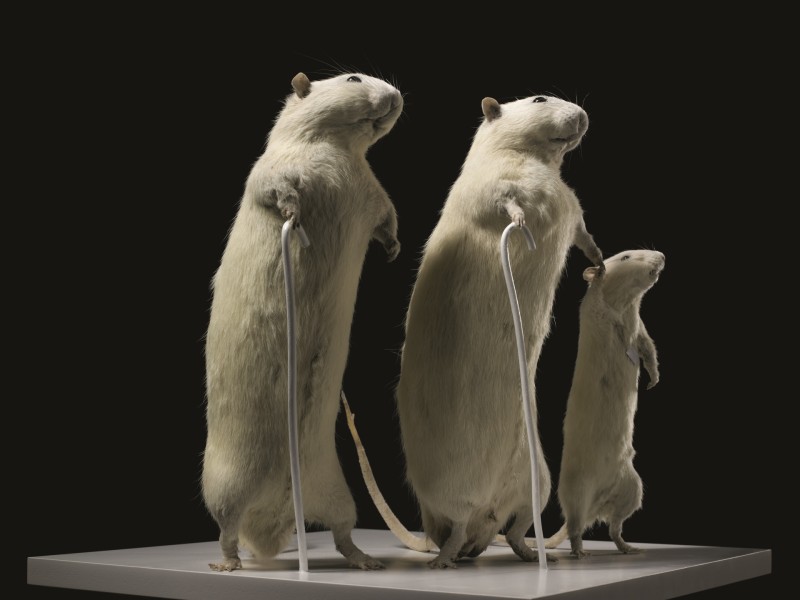
Deborah Sengl, The Last Days of Mankind. Stuffed rats and requisites on wooden pedestals, height dimension of the scene: variable, © Deborah Sengl, 2014. Photo: Mischa Nawrata, Wien.

At the Museum Dorotheergasse of the Jüdischen Museum Wien, the exhibition of Deborah Sengl’s taxidermic interpretation of Karl Kraus’s The Last Days of Mankind will continue through September 29, and if you’re in Vienna, you certainly should stop in and see it. (And with any luck the Austrian Cultural Forum here in New York will sit up and take notice.) I’ve written before about Sengl’s revealing perspective on Kraus’s great satiric masterpiece, and the museum itself offers its rationale for exhibiting the work right now:

The year 2024 is an election year. Throughout Europe, parties dreaming of “illiberal democracies” are gaining strength and attempting to persuade us that the term is not a contradiction. Society is polarized, with the social media echo chambers serving their own clientele and stirring up animosity to others. Pandemic and war have polarized public opinion even further, and the gap between rich and poor grows daily. Antisemitism and racism are omnipresent. Many people see this as a premonition of the last days of democracy, and Kraus, who celebrates his 150th anniversary this year, is more relevant than ever. That’s why the rats are back.

One of them will be on the debate stage in Philadelphia tonight. More information about the exhibition can be found here.

Back to Wien

A Baedeker map of Vienna, circa 1910.

I’ve been absent here over the summer, but my imagination and spirit carry me to Vienna still. As I continue to listen to — and supportradio klassik Stephansdom, I remain fascinated by the city’s fin-de-siècle culture, of course. However, in my reading I’m increasingly drawn to the city’s baroque and classical spirit of the seventeenth and eighteenth centuries as well: Stephansdom and Melk and Josef II; Mozart, Schubert, and Beethoven. For this I’m finding Ilsa Barea’s classic study of the city most appealing and can highly recommend that.

So I’m taking up my private German lessons again and searching for flights — a goal more aspirational than practical at the moment, but a boy can dream. He can also drink. I’m laying in a case of Haus Marke Red from the Moric winery in Burgenland, recently discovered thanks to Karen MacNeil’s Wine Bible, which is very good on the renaissance of Austrian wines, especially its reds. Moric makes fantastic reds. As Ms. MacNeil writes:

Roland Velich, owner and winemaker of Moric, is part crusader, part apostle. He rails against “uniform wines” made with the goal of getting high scores from critics. He denounces a wine industry geared to “fast money,” which leads to “fast wines suitable only for fast food.” He’s not the kind of guy with whom you have a casual conversation. And his wines aren’t casual either. His Blaufränkish is from old vines grown on terraced hillsides and made with the kind of artisanal care given Grand Cru Burgundy. It roars out of the glass, a juggernaut of flavor. White pepper, orange rind, cranberry, grenadine, pine forest — they all fall over themselves in a rush to get to you. There’s magnificent structure here too, and an impossibly long finish. Dramatic and unforgettable when young, the wine gets more and more beautiful as it ages.

I understand that the Haus Marke Red from Moric is a blend of Blaufränkisch, Rotburger, and Blauburgunder (Pinot Noir), but boy, that bouquet leaps out at you and though slightly fruity it’s deliciously dry. It’ll be in my wine rack soon, and I can’t wait. You can read an interview with Velich here.

From chaos to order and back again

Wilhelm Gauseː Court Ball in Vienna (1900).

In his study of fin-de-siècle Vienna, Carl Schorske turned not to Schoenberg, Berg, or Webern to introduce his themes, but to Maurice Ravel’s 1920 La valse. “I feel this work a kind of apotheosis of the Viennese waltz, linked in my mind with the impression of a fantastic whirl of destiny,” Ravel said, and Schorske wrote:

Ravel’s musical parable of a modern cultural crisis, whether or not he knew it, posed the problem in much the same way as it was felt and seen by the Austrian intelligensia of the fin-de-siècle. How had their world fallen into chaos? Was it because the individuals (in Ravel, the musical themes) contained in their own psyches some characteristics fundamentally incompatible with the social whole? Or was it the whole as such that distorted, paralyzed, and destroyed the individuals who composed it? … These questions are not new to humankind, but to Vienna’s fin-de-siècle intelligentsia they became central. Not only Vienna’s finest writers, but its painters and psychologists, even its art historians, were preoccupied with the nature of the individual in a disintegrating society.

As, I would add, am I. It is small comfort to realize that we’ve been here before, but we must take our comforts as they come.

To while away a few minutes today, you may wish to hear La valse itself. I’m quite fond of eccentrics; they are the spice of society, so long as they don’t shade into sociopaths, which they too often do. Below you’ll find Glenn Gould’s re-arrangement of Ravel’s solo piano arrangement of La valse in his 1974 series for the CBC, Music in Our Time. His introductory remarks are of interest as well.